
Yes. You can use money from a traditional IRA or 401(k) to buy a home in California, but the withdrawal is usually taxed as ordinary income by both the IRS and the Franchise Tax Board, and if you are under 59 1/2 you can owe an extra 10% federal tax plus 2.5% California tax unless an exception applies. The main exceptions and options are the $10,000 lifetime first time homebuyer exception (IRAs only), a 401(k) loan if your plan offers one, the age 55 separation from service rule (employer plans only), and spreading withdrawals across tax years so less of the money lands in a higher bracket. Talk to a CPA or tax advisor and your lender before you take any money out.
TL;DR
- You can use IRA or 401(k) money to buy a home, but traditional account withdrawals are taxed as income, federal and California.
- Under 59 1/2, expect an extra 10% federal and 2.5% California tax unless an exception applies.
- First-time buyers can take up to $10,000 from an IRA without the 10% penalty. Income tax still applies, and it does not cover 401(k)s.
- A 401(k) loan avoids tax if you repay it, up to the lesser of $50,000 or the greater of $10,000 or half your vested balance.
- Spreading withdrawals across tax years can keep more dollars in lower brackets.
- Talk to your CPA and lender before you withdraw.
This guide is general education, not tax advice.
Can you use retirement money to buy a house in California?
Yes, you can. Nothing stops you from pulling money out of a traditional IRA or 401(k) and putting it toward a home. The question is what it costs you. There are three costs to watch:
- Federal income tax. The taxable part of the withdrawal is added to your income for the year.
- California income tax. California taxes it as income too.
- Early distribution taxes if you are under 59 1/2. That is an extra 10% federal and an extra 2.5% California, unless an exception applies.
I wrote this guide for a specific group of people I talk with a lot here in the Antelope Valley: retirees and near retirees, downsizers who are selling one home and buying another, and buyers moving up from Los Angeles who want to buy in Lancaster or Palmdale with a smaller mortgage or none at all. If that sounds like you, you probably already have retirement savings, and you want to know how to use them without handing more than you need to the IRS and the FTB.
If you are a younger first time buyer, down payment assistance may be a better fit than your retirement account. Start with my first time buyers page and my Antelope Valley first time home buyer guide.
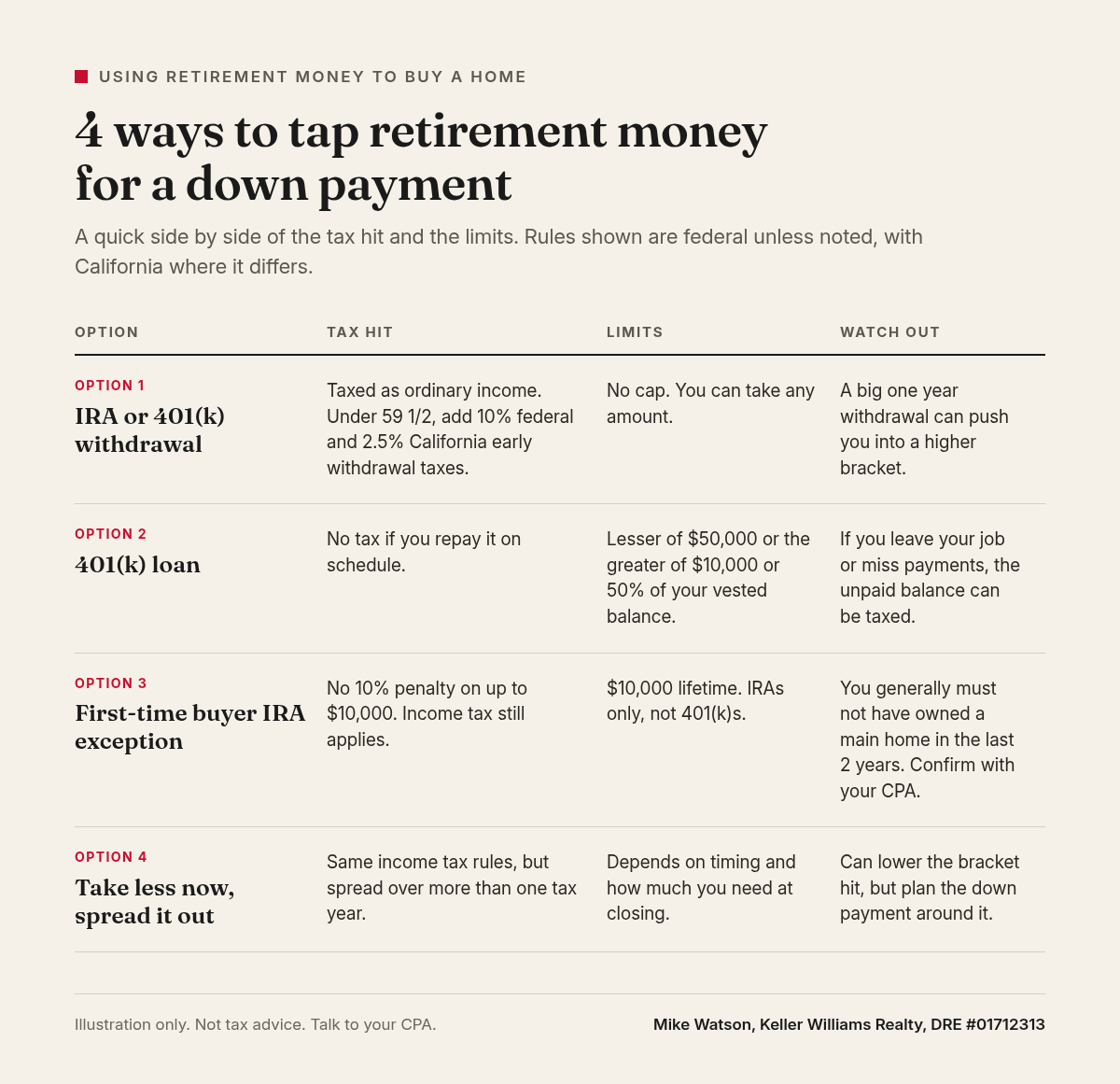
Option 1: Take a withdrawal from a traditional IRA or 401(k)
This is the simplest option, and for many buyers over 59 1/2 it is the one they end up using. Here is how it works.
How the withdrawal is taxed
Money you take out of a traditional IRA or 401(k) is generally taxed as ordinary income, both federally and in California. It is added to everything else you earn that year.
One exception to know about: if you made nondeductible contributions to your IRA over the years (called "basis"), part of the withdrawal may come out tax free. Form 8606 is how that basis is tracked (IRS Publication 590-B). If you are not sure whether you have basis, your CPA can check your old returns.
The early withdrawal taxes if you are under 59 1/2
If you are under 59 1/2, the IRS generally adds a 10% additional tax on the taxable part of the distribution (IRS Topic 557 for IRAs, Topic 558 for employer plans).
California adds its own. The FTB charges a 2.5% additional tax on the taxable part of an early distribution, or 6% for SIMPLE plan money taken in the first 2 years of participation. It is figured on Form FTB 3805P (FTB early distributions page).
After 59 1/2
Once you are 59 1/2 or older, the 10% federal and 2.5% California additional taxes do not apply. Regular federal and California income tax still does.
The age 55 rule for 401(k) money
If you leave your job in or after the year you turn 55, distributions from that employer's plan avoid the federal 10% additional tax. For certain public safety employees, the age is 50 (IRS exceptions table). This rule does not apply to IRAs.
California follows this one for plans. The FTB 3805P instructions list it as exception 01 and say it does not apply to IRAs. So if you are 56, recently retired, and your money is still in your old employer's 401(k), think twice before rolling it into an IRA and then withdrawing. Ask your CPA about the order of steps first.
Withholding is not the same as your tax bill
This one catches people at closing. Employer plan payouts that are eligible rollover distributions have mandatory 20% federal withholding (IRS Topic 413). IRA payouts that are not periodic default to 10% federal withholding unless you choose a different amount on Form W-4R (Publication 590-B).
That means if you ask for $100,000 from a 401(k), you may only receive $80,000. And your real tax bill can be higher or lower than what was withheld. Plan your closing funds around the net amount that actually lands in your account, and have your CPA estimate what you will owe in April.
Option 2: Borrow from your 401(k)
A 401(k) loan lets you use your money without it counting as a withdrawal, as long as you pay it back on time. A few things to know (IRS Retirement Plans FAQs regarding loans):
- Only if your plan offers loans. Plans are allowed to offer loans but are not required to. Call your plan administrator and ask.
- No loans from IRAs. You cannot take a loan from an IRA, and pledging an IRA as security for a loan counts as a distribution (Publication 590-B).
- How much. The limit is the lesser of $50,000 or the greater of $10,000 or 50% of your vested balance.
- Repayment. Generally within 5 years, in substantially equal payments made at least quarterly. A loan used to buy your main home can have a longer term if your plan allows it.
- Spousal consent. Your plan may require your spouse to sign off.
- The risk. If you miss payments, or you leave your job and the loan is not repaid under the plan's rules, the unpaid balance can become a taxable "deemed distribution." If you are under 59 1/2, the early distribution tax can apply too.
One more thing to ask about: how your lender will count the 401(k) loan payment when it qualifies you for a mortgage. That depends on the lender and the loan program, so get the answer from your lender directly.
Option 3: The $10,000 first time homebuyer exception (IRAs only)
This part surprises a lot of retirees. You may count as a "first time homebuyer" even if you have owned homes before.
Here is how the exception works (Publication 590-B and the IRS exceptions table):
- What it does. Up to $10,000 lifetime from an IRA avoids the federal 10% additional tax. Regular income tax still applies to a traditional IRA withdrawal.
- Who counts as a first time homebuyer. You (and your spouse, if married) had no present ownership interest in a main home during the 2 years ending on the date you acquire the new one. So if you sold your last home years ago and have been renting since, you may qualify.
- Who the home can be for. You, your spouse, or your or your spouse's child, grandchild, parent, or other ancestor. A grandparent can use it to help a grandchild buy.
- Married couples. Each spouse who qualifies can use up to $10,000 from their own IRA.
- What the money can pay for. Qualified acquisition costs, meaning the cost of buying, building, or rebuilding the home, plus usual settlement, financing, or closing costs. The money has to be used within 120 days. If the deal is canceled or delayed, you can put the money back within 120 days. For a sense of what closing costs look like locally, see my guide to the cost to buy a home in Lancaster and Palmdale.
- Not for 401(k)s. The exception does not apply to 401(k) or other employer plans. The IRS exceptions table marks it "no" for qualified plans.
California matches this exception for IRAs only. The FTB 3805P instructions list it as exception 09, so the 2.5% California additional tax does not apply to that amount either.
Roth IRAs
A Roth IRA distribution used for a first home, up to the same $10,000 lifetime limit, can be a qualified tax free distribution if the 5 year rule is met (Publication 590-B). Roth rules have a few moving parts, so have your CPA confirm before you take the money.
Option 4: Take less now, pay down later, and spread withdrawals across tax years
Many people have not heard of this option. Instead of taking one big withdrawal in one year, you:
- Finance part of the purchase with a mortgage.
- Take a smaller withdrawal this year.
- Take more in a later tax year and use it to pay the loan down.
Why it can help. Federal tax brackets are progressive. A large withdrawal in a single year can push some of those dollars into a higher bracket. Splitting it across two years can keep more of the money in a lower bracket. The illustration below shows how that works.
What about California? California's brackets are progressive too. But in the illustration below, all of the money stays in the same 9.3% California band either way, so the California saving in that example is zero. Whether you would save anything on the California side depends on your own numbers.
Ask about a recast. Some lenders let you make a large principal payment and then re-amortize the loan to a lower monthly payment. This is often called a "recast." Whether it is offered, the minimum payment, and any fee are up to the lender. Ask your lender whether they offer a recast and what it costs.
Other things a higher income year can change. Medicare Part B and Part D income related premiums (IRMAA) are based on your income (SSA). A big withdrawal year could affect them. Required minimum distributions start at age 73 (Publication 590-B), and any planned withdrawals will interact with those. Both are good questions for your CPA.
If you are selling a home with a reverse mortgage to fund the next one, that adds its own steps. See my guide on selling a home with a reverse mortgage and my reverse mortgage sales page.
Fixed or adjustable rate if you plan to pay down the loan
If your plan is to take a mortgage now and pay it down later, the loan type matters. The Consumer Financial Protection Bureau (CFPB) explains it this way:
- Fixed rate. The interest rate is set when you take out the loan and does not change.
- Adjustable rate (ARM). The rate can go up or down after an introductory period, and your payment is likely to go up when it adjusts.
The CFPB also cautions buyers not to assume they will be able to sell or refinance before the rate changes. That applies here too. If your plan depends on a second withdrawal next year to pay the loan down, ask your lender two things: how a recast or payoff works on each loan type, and whether you could still afford the payment if that second withdrawal never happens.
Illustration: one big withdrawal vs spreading it over two years
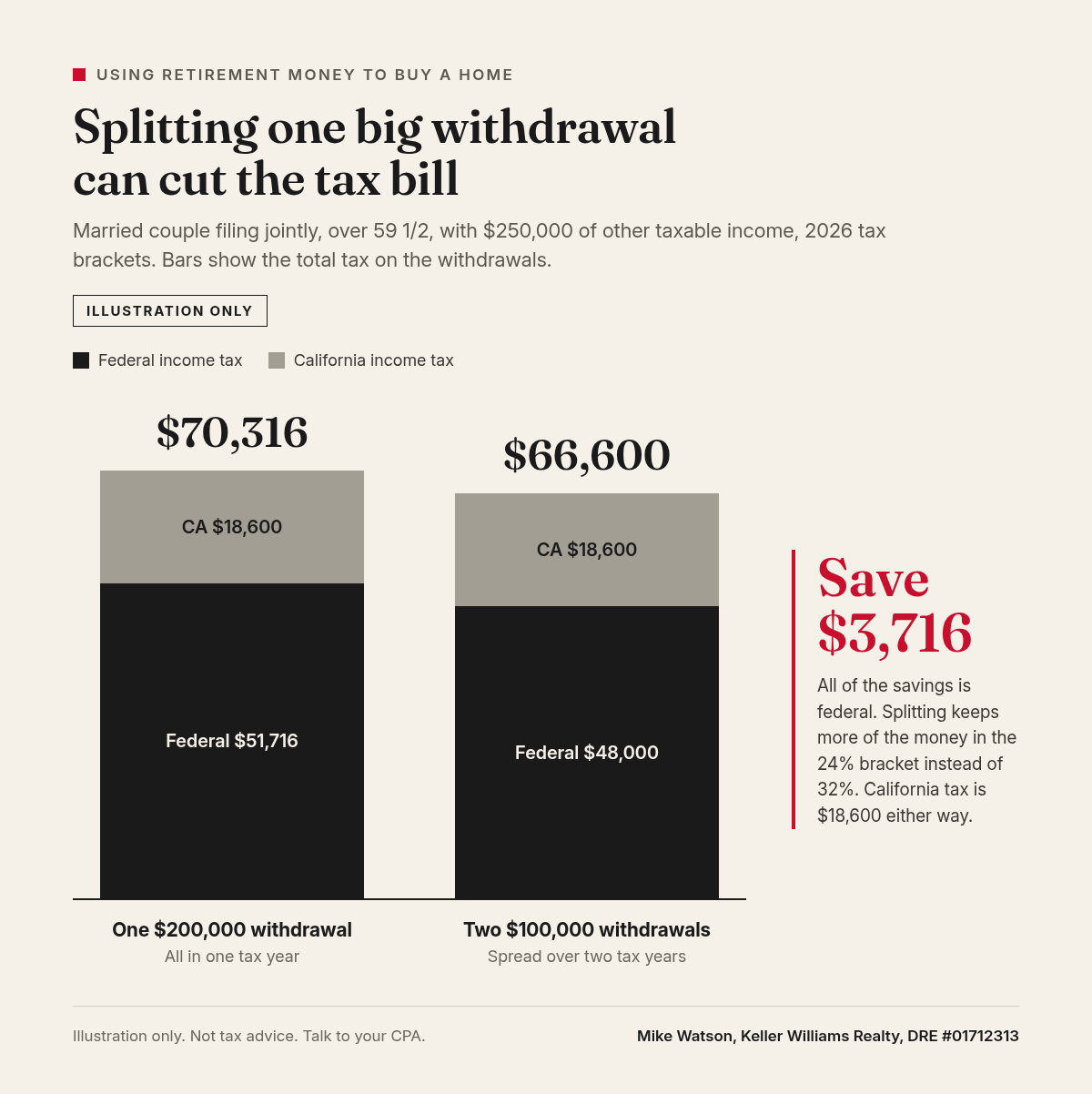
Illustration only. Not tax advice. Numbers are made up to show how brackets work.
Assumptions:
- A married couple filing jointly, both over 59 1/2, so no early distribution taxes apply.
- Taxable income of $250,000 before the withdrawal (after deductions). That puts them in the 24% federal bracket and the 9.3% California bracket.
- They want $200,000 from a traditional IRA with no basis.
- Spread version: $100,000 this year and $100,000 next year, with the same other income. For simplicity, both years use 2026 brackets. Next year's brackets will be adjusted for inflation.
- Everything else is ignored, including Social Security, IRMAA, credits, other deductions, and withholding timing.
2026 brackets used (married filing jointly): federal 24% from $211,400 to $403,550 and 32% from $403,550 to $512,450 (IRS Rev. Proc. 2025-32 and IR-2025-103). California 9.3% from $150,394 to $768,218 (FTB Tax News, October 2026).
| One year: $200,000 | Two years: $100,000 + $100,000 | |
|---|---|---|
| Federal tax on the withdrawal | $51,716 ($153,550 at 24% = $36,852, plus $46,450 at 32% = $14,864) | $48,000 ($24,000 each year, all at 24%) |
| California tax on the withdrawal | $18,600 (all at 9.3%) | $18,600 ($9,300 each year) |
| Total | $70,316 | $66,600 |
| Difference | $3,716 less federal tax in this example |
If the same couple were under 59 1/2 with no exception, the early distribution taxes alone on $200,000 would be $20,000 federal (10%) and $5,000 California (2.5%), on top of the income tax above.
The takeaway is not the exact dollar figure. It is that timing can change your tax bill, and it is worth having a CPA run both versions with your real numbers before you decide. If you are coming from LA and weighing how far your money goes here, my comparison of what $500K buys in Los Angeles vs the Antelope Valley can help you size the purchase.
Can you buy a house inside your IRA and live in it?
No. Using IRA funds to buy property for your personal use, now or in the future, is a prohibited transaction (Publication 590-B). A self directed IRA can own investment real estate under strict rules, but you cannot live in it.
If you already own property inside an IRA and are thinking about selling, see my guide on selling real estate owned by an IRA.
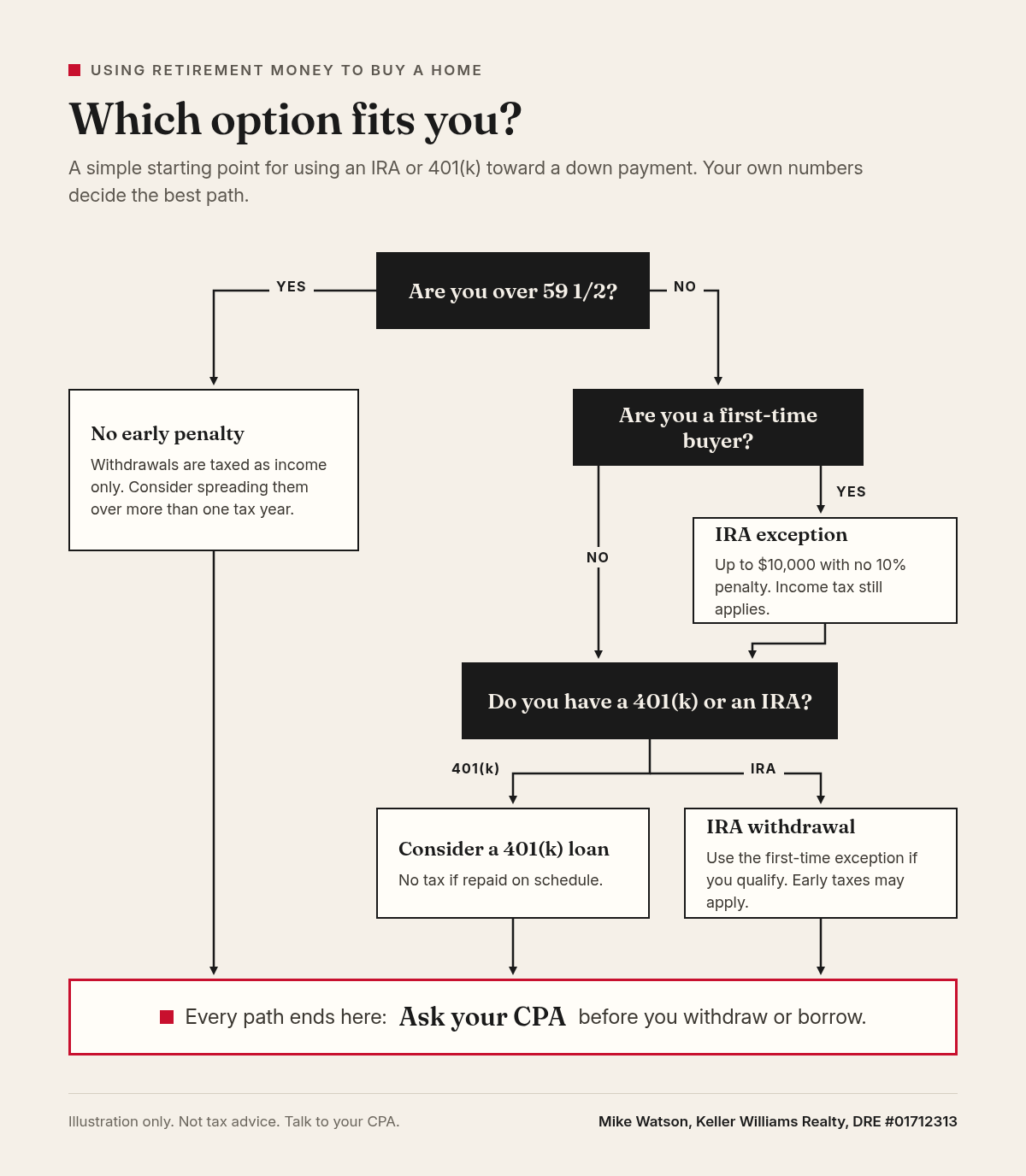
Before you withdraw: talk to your CPA and your lender
Every situation is different. Before you move retirement money, ask a CPA or tax advisor to run your federal and California numbers, and ask your lender how a withdrawal, a 401(k) loan, or a later paydown fits your loan. I can connect you with local professionals, but I don't give tax advice.
Frequently asked questions
Can I use my 401(k) to buy a house without penalty?
Yes, if you are 59 1/2 or older, if you left that employer in or after the year you turned 55, or if you take a plan loan and repay it on schedule. The $10,000 first time homebuyer exception does not apply to 401(k)s, only to IRAs. Regular federal and California income tax still applies to any withdrawal you take.
Does California charge a penalty on early retirement withdrawals?
Yes. California adds a 2.5% tax on the taxable part of an early distribution (6% for SIMPLE plan money in the first 2 years of participation), on top of the federal 10%, unless a California exception applies. It is figured on Form FTB 3805P, and California does not follow every federal exception.
Who counts as a first time homebuyer for the IRA exception?
Someone who, along with a spouse, had no ownership interest in a main home during the 2 years ending on the date they sign the purchase contract or start building. That means many retirees who sold a home years ago and have rented since can qualify, even though they have owned before.
Can I use my IRA $10,000 to help my child or grandchild buy a home?
Yes. The exception covers a home for you, your spouse, or your or your spouse's child, grandchild, parent, or other ancestor, up to $10,000 lifetime. Each qualifying spouse can use up to $10,000 from their own IRA, and the money must be used for qualified costs within 120 days.
How much of a 401(k) can I borrow for a home?
Up to the lesser of $50,000 or the greater of $10,000 or 50% of your vested balance, if your plan offers loans. Repayment is generally within 5 years, though a loan to buy your main home can run longer if the plan allows. If it is not repaid under plan rules, it can become taxable.
Is it better to withdraw all at once or over two years?
Often spreading it can keep more of the money in a lower federal bracket, but it depends on your income, deductions, and other items. In a generic 2026 example, two $100,000 withdrawals cost $3,716 less in federal tax than one $200,000 withdrawal. Have a CPA model both versions with your real numbers.
Will taxes be withheld from my withdrawal?
Employer plan payouts usually have 20% federal withholding. IRA payouts default to 10% federal unless you choose a different amount on Form W-4R. Withholding is a prepayment, not your final tax, so your actual bill can be higher or lower. Plan your closing funds around the net amount you receive.
Can I buy a home with my IRA and live in it?
No. Using IRA funds to buy property for personal use is a prohibited transaction. A self directed IRA can hold investment real estate under strict rules, but you cannot live in it. If you already own property inside an IRA, talk to your CPA and your IRA custodian before you make any changes.
Buying in the Antelope Valley with retirement money?
Buying in Lancaster, Palmdale, or the Antelope Valley? I've been in real estate since 2002, first as an assistant, and licensed since 2005, and I can help you line up the right people. Reach out and tell me what you are planning, and I'll help you put together the questions to bring to your CPA and lender.
Sources
- IRS Topic 557, Additional tax on early distributions from traditional and Roth IRAs
- IRS Topic 558, Additional tax on early distributions from retirement plans other than IRAs
- IRS Retirement topics, Exceptions to tax on early distributions
- IRS Publication 590-B, Distributions from IRAs
- IRS Retirement plans FAQs regarding loans
- IRS Topic 413, Rollovers from retirement plans
- IRS IR-2025-103, 2026 tax inflation adjustments
- IRS Rev. Proc. 2025-32 (2026 bracket tables)
- California FTB, Early distributions
- California FTB, 2025 Instructions for Form FTB 3805P
- California FTB, Tax News October 2026 (2026 California brackets)
- CFPB, Fixed rate vs adjustable rate mortgage
- SSA, Medicare IRMAA and requesting a lower amount
This article is general education, not tax, legal, or financial advice. Talk to a CPA or tax advisor and your lender about your situation before you withdraw or borrow retirement money.