
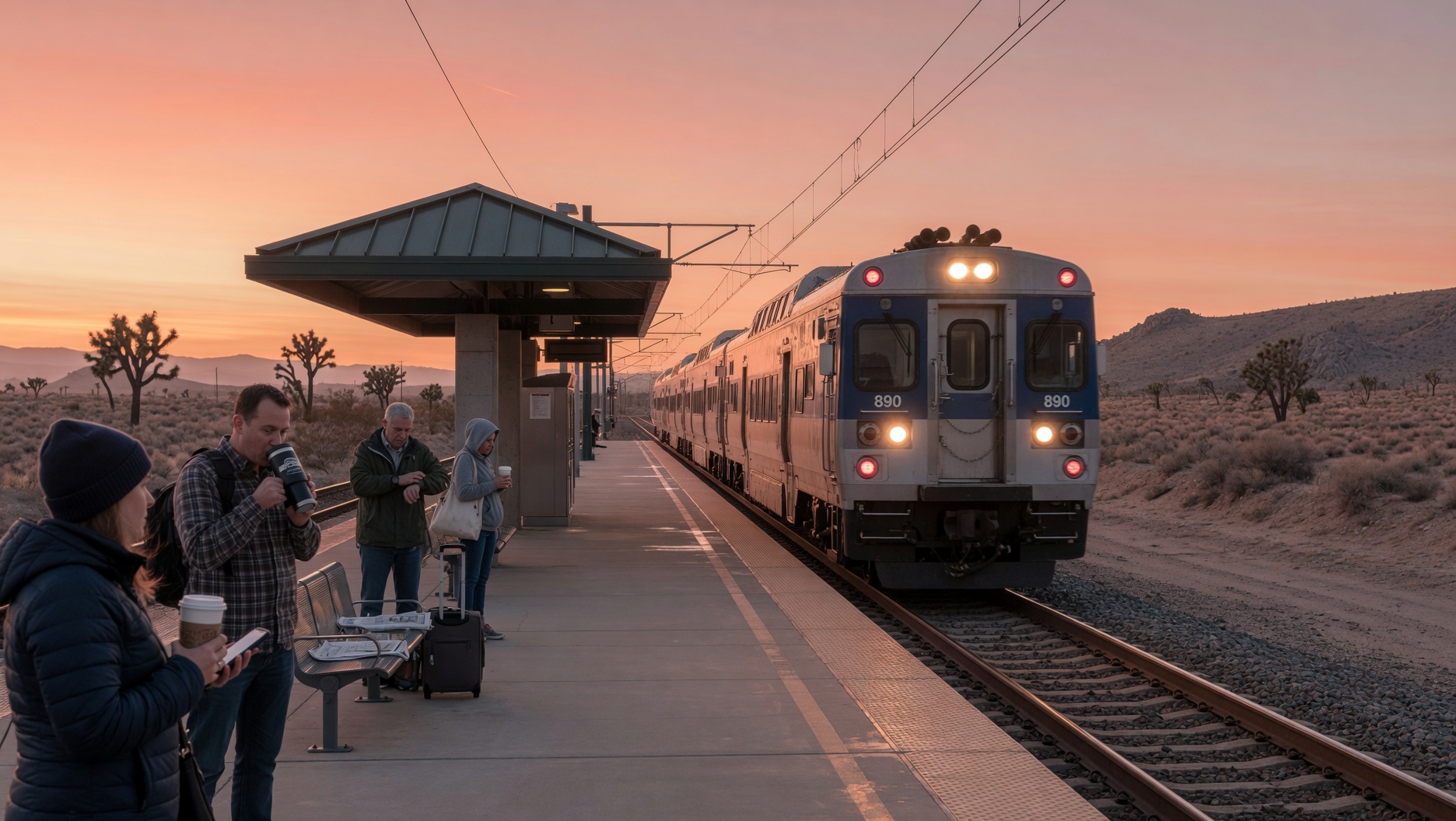
The case for buying a home in the Antelope Valley and commuting to Los Angeles on the Metrolink Antelope Valley Line is either the smartest housing arbitrage in Southern California or a quality-of-life mistake, depending on who you ask. The honest answer is somewhere in between, and which side of the line you land on depends on five specific factors I will walk through in this post.
I'm Mike Watson, a full-time AV Realtor since 2002. I have helped commuter-buyers move into both Lancaster and Palmdale, and I have helped some of them sell and move back. This guide is the no-spin take on the math, the time, the lifestyle reality, and what 23 years of AV price history say about whether the housing savings are big enough to make the commute worth it.
Considering the AV commute play? Run the housing-cost difference on the Net Sheet Calculator. Run the numbers on what you''d save by moving to the AV.
The Metrolink Antelope Valley Line: What It Actually Is
The Metrolink Antelope Valley Line runs from Lancaster Station (the terminus) south through Palmdale, Vincent Grade / Acton, Via Princessa, Santa Clarita (Newhall and Santa Clarita stations), Sylmar / San Fernando, Burbank, Glendale, and into Los Angeles Union Station. Total route length is about 76 miles.
Key stations in the AV:
- Lancaster Station (44812 Sierra Hwy): Terminus, free parking, served by AV Transit Authority buses
- Palmdale Transportation Center (39000 Clock Tower Plaza): Central Palmdale, also future California High-Speed Rail station, paid + free parking mix
- Vincent Grade / Acton (842 W Sierra Hwy, Acton): Rural station, free parking, serves Acton, Agua Dulce, and northern Santa Clarita Valley
For 2026 schedules, fares, and live status, see Metrolink''s official Antelope Valley Line page at metrolinktrains.com.
The Travel Time Reality
Marketing materials will quote you the headline number. I will quote you what your commute door-to-door actually takes.
| Origin Station | Train Time to Union Station | Door-to-Door Realistic (Lancaster commuter) | Door-to-Door Realistic (Palmdale commuter) |
|---|---|---|---|
| Lancaster Station | ~2h 5m | 2h 30m-2h 50m | n/a |
| Palmdale Transportation Center | ~1h 55m | n/a | 2h 15m-2h 40m |
| Vincent Grade / Acton | ~1h 40m | 2h 5m-2h 30m (drive 25 min) | 2h 10m-2h 35m (drive 30 min) |
| Newhall (Santa Clarita) | ~1h 10m | n/a (this is SCV not AV) | n/a |
Door-to-door includes parking, station wait time, walking from Union Station to destination, and a 10-minute buffer for typical delays. 2026 Metrolink AV Line schedules; verify before relying.
The Cost Math: Monthly
| Item | Monthly Cost |
|---|---|
| Metrolink Monthly Pass (zone 9 Lancaster, 2026) | ~$385 |
| Parking at Lancaster Station | $0 (free) |
| Last-mile transit (Metro TAP card, free transfer) | ~$0-$30 |
| Coffee + snacks budget (be honest) | ~$80 |
| Avg gas cost (driving to/from Lancaster station) | ~$60 |
| Total monthly | ~$525-$555 |
Compare to driving solo from Lancaster to Downtown LA: roughly 130-150 round-trip miles per day, $750 to $1,100 per month in fuel plus 22 to 28 hours per week behind the wheel. Metrolink wins on cost and stress; loses on flexibility.
The 23-Year AV Housing Savings: Why The Commute Math Works
The whole premise of the AV Metrolink commute is housing-cost arbitrage. Here is what 23 years of indexed sales data say about the savings versus a comparable LA basin neighborhood.
| Year | AV Median (Lancaster) | Burbank Median | Burbank Premium (multiple) |
|---|---|---|---|
| 2003 | $185,000 | $425,000 | 2.3x |
| 2006 | $355,000 | $795,000 | 2.2x |
| 2009 | $135,000 | $555,000 | 4.1x |
| 2013 | $215,000 | $685,000 | 3.2x |
| 2018 | $310,000 | $945,000 | 3.0x |
| 2022 | $455,000 | $1,275,000 | 2.8x |
| 2024 | $395,000 | $1,195,000 | 3.0x |
| 2026 (Q1) | $408,000 | $1,235,000 | 3.0x |
Source: Mike Watson MLS archive for AV (Lancaster) data. Burbank data via CRMLS comparable medians. Live interactive AV chart at Market Stats.
The pattern that matters: an LA-basin neighborhood at a comparable Metrolink commute distance has consistently cost 2.3x to 4.1x what the AV has cost over the 23-year window. As of 2026, Burbank costs 3.0x what Lancaster does. On a $400K Lancaster home versus a $1.2M Burbank home, the monthly P&I difference at 6.25% is roughly $4,750. Even with $525 in monthly commute costs and the time tax, the dollar arbitrage is the most consistent housing trade in Southern California.
The Buyer Profiles That Make This Work
Honest take on which commute profiles actually succeed at the AV Metrolink life:
Works Well For
- 3-4 day in-office hybrid schedules. The math works much better when you only ride 3 days a week. Many AV-based commuters have shifted to this.
- Knowledge workers who can do real work on the train. The 1.5-to-2 hours each way becomes productive desk time if you have a laptop and a quiet car habit.
- Family-priority buyers. The $4,000+/month housing-cost difference funds private school, college savings, or earlier mortgage payoff.
- Pre-IPO startup employees with restricted geography for tax purposes. If you cannot relocate out of California, AV is the cheapest housing inside the state with reasonable LA access.
- Anyone working at Burbank Airport, the major studios, or downtown LA. Burbank is roughly 1h 25m on the train from Palmdale.
Does Not Work For
- 5-day-in-office schedules. 25+ hours per week on the train wears most people out within 18-24 months.
- Workers with unpredictable hours. The Metrolink AV Line schedule is sparse; missing the last train (typically ~10:30 PM) means a $200+ Uber home.
- School pickup parents. If you are the parent doing 3 PM pickup, you are not on a 4:30 PM train south.
- Healthcare and on-call professionals. Emergency callbacks do not work over a 2-hour rail commute.
Best AV Submarkets for Metrolink Commuters
Not every AV neighborhood is a viable Metrolink commute. The four submarkets that work:
| Submarket | Drive to Station | 2026 Median Price | Why |
|---|---|---|---|
| Central Lancaster (near BLVD) | 5-10 min to Lancaster Stn | $385,000 | Closest to Lancaster Station, walkable downtown |
| Palmdale Civic Center | 5-12 min to Palmdale TC | $445,000 | Closest to PTC; future HSR station |
| Anaverde / SW Palmdale | 10-18 min to PTC | $540,000 | Master-planned, family-friendly, manageable station drive |
| Acton (near Vincent Grade) | 5-15 min to Vincent Grade | $625,000 | Closest commute on the line at 1h 40m to Union Station |
Source: Mike Watson MLS archive, March 2026 medians.
The Bear Case: When the AV Commute Stops Working
I am not going to oversell it. Here is when the AV-to-LA Metrolink commute stops working for most people:
- When work shifts back to 5 days in office. Pre-pandemic, AV Metrolink ridership was lower because the time cost was punishing. If your employer mandates a full return-to-office, reassess.
- When the rate environment makes the LA-basin home affordable. If a 5.0% mortgage rate returns and your income has grown, the LA basin gap narrows. Run the comparison annually.
- When kids'' school activities shift the calculus. Travel sports, evening tutoring, and high school start times make the 6 AM departure painful.
- When the spouse stops liking it. The commute is not just the commuter''s experience; it is the partner-doing-all-the-pickups'' experience too.
How to Test the Commute Before You Buy
The honest advice I give every commuter-buyer: do the commute three times before you write an offer. Pay $30 each way for the day pass, drive to Lancaster Station at your real intended departure time, ride the train, walk to your real intended destination, and ride back. Do it on a Monday, a Tuesday, and a Thursday. Almost half of would-be AV Metrolink commuters discover after the test trips that the schedule does not fit their lives. The other half know within the first ride that this is exactly what they want.
The Realtor''s Take
The AV Metrolink commute is one of Southern California''s most durable arbitrage trades, but it is not a universal solution. The buyers who succeed in this profile share a few traits: hybrid schedules, knowledge work that travels well, partners who genuinely understand what they are signing up for, and families that value the housing-cost savings enough to spend them on something specific (private school, college funds, faster mortgage payoff).
If you are seriously considering this move, the first step is to know what you would actually save. Open the Net Sheet Calculator, run a comparable AV home next to your LA basin scenario, and see the real numbers. Run the numbers on what you''d save by moving to the AV.
Then ride the train three times. Then call me.
Frequently Asked Questions: Metrolink Antelope Valley Line Commute
How long is the Metrolink commute from Lancaster to LA Union Station?
The train portion is approximately 2 hours and 5 minutes from Lancaster Station to LA Union Station. Door-to-door including parking, station wait, walking from Union Station, and typical delays runs 2 hours 30 minutes to 2 hours 50 minutes each way.
How much does a Metrolink monthly pass from Lancaster cost in 2026?
Approximately $385 per month for a zone 9 monthly pass covering Lancaster to LA Union Station. Last-mile Metro transit transfers are included. Total monthly commute cost (pass + station drive + incidentals) typically runs $525 to $555.
Is the Antelope Valley Metrolink commute worth it?
For most knowledge workers on hybrid schedules (3 to 4 days in office), yes. The housing-cost arbitrage versus comparable LA basin neighborhoods runs roughly $3,500 to $5,000 per month at 2026 prices, more than 7x the monthly commute cost. For 5-day-in-office workers and on-call professionals, the time tax usually outweighs the savings.
Where do most Metrolink commuters live in the Antelope Valley?
The four highest-volume commuter submarkets are central Lancaster (near BLVD and Lancaster Station), Palmdale Civic Center (near PTC), Anaverde / SW Palmdale (10-18 minutes to PTC), and Acton (near Vincent Grade station). Submarket selection should optimize for short station drive + good neighborhood fit.
Can I work on the Metrolink train?
Yes. The AV Line has WiFi, power outlets, table seating, and quiet cars. Many commuters report that the train portion is the most productive 1.5 to 2 hours of their work day. The trade-off is variable WiFi reliability and the occasional crowded car.
What time is the first Metrolink train from Lancaster?
The earliest weekday southbound train typically departs Lancaster Station around 4:30 AM, arriving Union Station around 6:35 AM. Verify the current schedule at metrolinktrains.com before relying on a specific departure.
Will high-speed rail change the AV commute?
Yes, significantly. The California High-Speed Rail Palmdale station is planned at the Palmdale Transportation Center, projected to deliver Palmdale-to-LA in under 30 minutes when operational. The timeline remains the subject of ongoing project updates. See our California HSR Palmdale impact post for the full analysis.
How much do I save buying in the AV instead of Burbank or Glendale?
Based on 2026 median prices, an AV home runs roughly one-third the cost of a comparable Burbank home ($408K vs $1,235K Lancaster vs Burbank median). On a 30-year fixed at 6.25%, the monthly P&I difference is approximately $4,750. The 23-year compound housing-cost gap has consistently ranged between 2.3x and 4.1x.